Christianity: Imago Dei in the Age of Technology
Christianity has long taught that humanity is created in the image of God. In the age of biotechnology, artificial intelligence, and human enhancement, a new question emerges: what does it mean to bear that image in a world where human beings may soon reshape their own evolution?
By Minister Edinger • Weekly Digital Worship Service
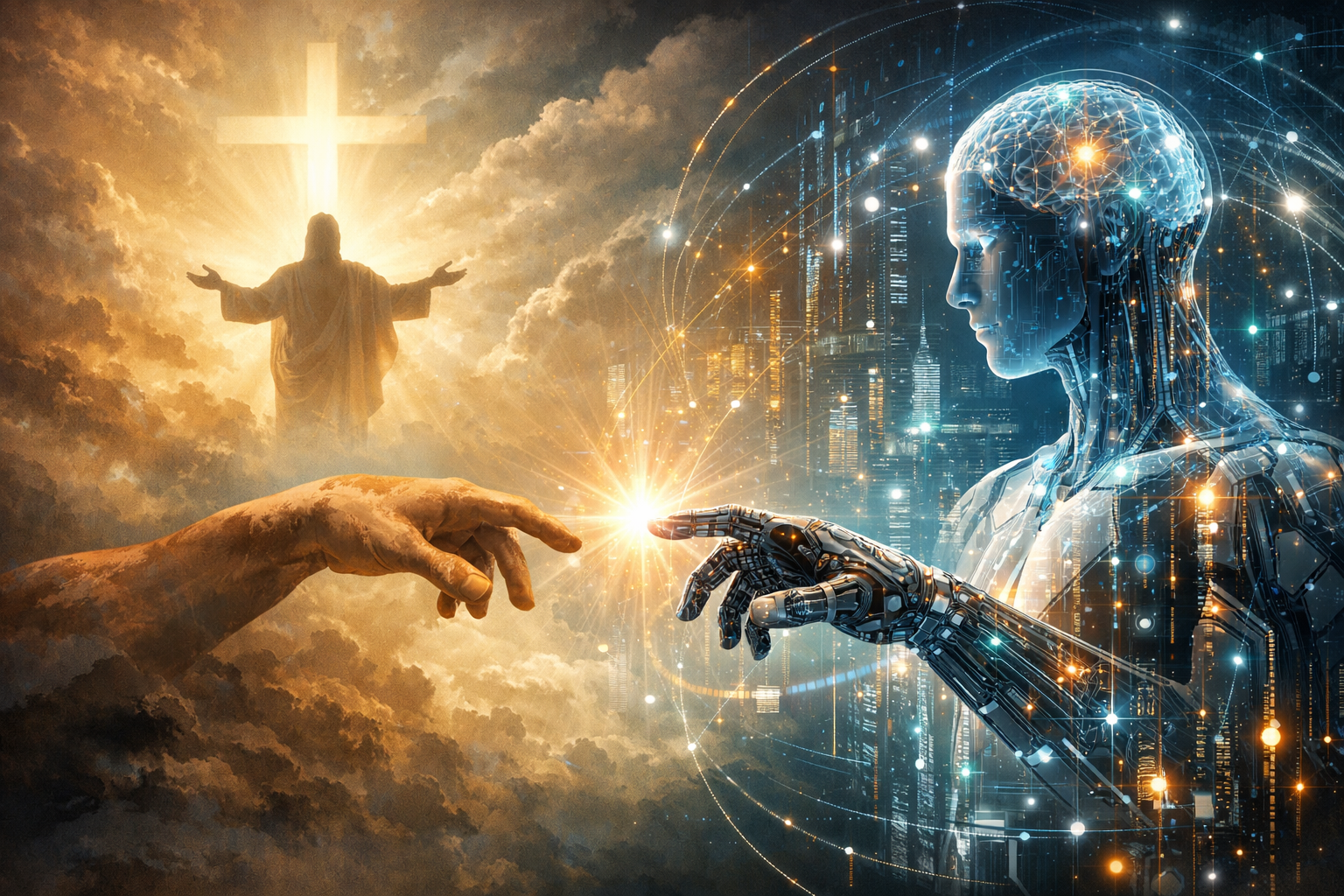
Created in the Image of God
For centuries, Christian theology has affirmed a profound and mysterious idea: that human beings are created in the Imago Dei — the image of God. This concept has often been interpreted metaphorically, referring to humanity’s capacity for moral reasoning, creativity, compassion, and spiritual awareness. Unlike other creatures, human beings possess the ability to imagine futures that do not yet exist and to act intentionally in shaping them.
Yet history reveals that the meaning of this idea has always evolved alongside human understanding. In ancient times, bearing the image of God implied stewardship of the natural world. During the scientific revolution, it came to include the pursuit of knowledge and the disciplined exploration of nature’s laws. Today, as biotechnology and artificial intelligence expand the frontiers of possibility, the concept of Imago Dei may be entering a new phase.
For the first time in history, humanity possesses tools capable of reshaping its own biological foundations.
Humanity as Co-Creator
The rapid progress of modern science has revealed that life itself is not an untouchable mystery but a system governed by discoverable principles. Technologies such as gene editing, neural engineering, and advanced prosthetics are increasingly capable of repairing or enhancing the human organism.
Institutions such as MIT’s biotechnology research programs are exploring genetic therapies that may treat diseases once thought permanent. Meanwhile, work in neuroscience and brain-machine interfaces described by Harvard Medical School’s neuroscience initiatives continues to uncover how the brain encodes memory, identity, and perception.
These discoveries do more than expand medical capability. They suggest that humanity may be entering a stage in which biological evolution itself becomes partially guided by conscious intention.
For Christians reflecting on the meaning of the Imago Dei, this possibility raises a remarkable theological interpretation: perhaps humanity’s creative capacity — including its technological creativity — is not a deviation from divine design but an expression of it.
“If humanity bears the image of a creative intelligence, then the act of responsible creation may itself be an expression of that image.”
Technology and the Expansion of Human Potential
Consider how dramatically human capabilities have already expanded through technology. Tools extend physical strength. Medicine prolongs life. Communication networks allow ideas to move across the planet instantly. Artificial intelligence now assists researchers in discovering new materials, medicines, and scientific insights.
Research organizations such as DARPA’s Biological Technologies Office are investigating ways to repair neural injuries, enhance resilience in extreme environments, and integrate biological and digital systems. Such innovations suggest that the boundaries between biology and technology may become increasingly fluid.
From a purely technological perspective, these developments represent progress. From a spiritual perspective, they may represent something deeper: the unfolding of humanity’s creative vocation.
Christian thinkers have long described humanity as a steward of creation. But stewardship implies more than preservation; it also implies cultivation. Gardens flourish when tended carefully. Civilizations flourish when knowledge is guided by wisdom.
The Ethics of Becoming
If technology enables humanity to reshape aspects of its own biology, the moral responsibility accompanying that power becomes immense. Enhancement without ethical reflection could deepen inequality, create new forms of coercion, or erode the dignity of human life.
The Christian tradition has always emphasized humility in the face of great power. Technological capability alone does not guarantee wisdom. Indeed, the greater humanity’s creative power becomes, the more urgently moral reflection is required.
This is why the question is not simply whether technologies of enhancement should exist. The deeper question is how humanity should guide their development.
If humanity truly bears the image of a creative intelligence, then technological civilization may represent a continuation of that creative process. But like all sacred responsibilities, it must be exercised with compassion, foresight, and reverence for conscious life.
Reflection — Christianity teaches that humanity is created in the image of God. In an age when science increasingly grants the power to reshape life itself, the meaning of that image may expand. The challenge of our era is not simply technological progress, but ensuring that progress reflects humanity’s highest values.
Key Concepts
- Imago Dei — the theological concept that human beings are created in the image of God.
- Human Enhancement — technologies that expand physical or cognitive abilities through biotechnology or cybernetic systems.
- Bioengineering — the scientific discipline of designing or modifying biological systems.
- Neurotechnology — technologies that interact directly with the nervous system or brain.
- Technological Evolution — the idea that humanity’s development may increasingly be shaped by intentional technological design.
Scientific Sources and Further Study
Readers interested in the intersection of biotechnology, neuroscience, and human enhancement may explore the following research institutions.