The Sacred Project of Radical Life Extension
For millennia, death was treated as destiny. Today, longevity science is beginning to ask a different question: what if aging itself is not a law of nature, but a condition that can be understood, delayed, and perhaps one day profoundly transformed?
By Minister Edinger • Weekly Digital Worship Service
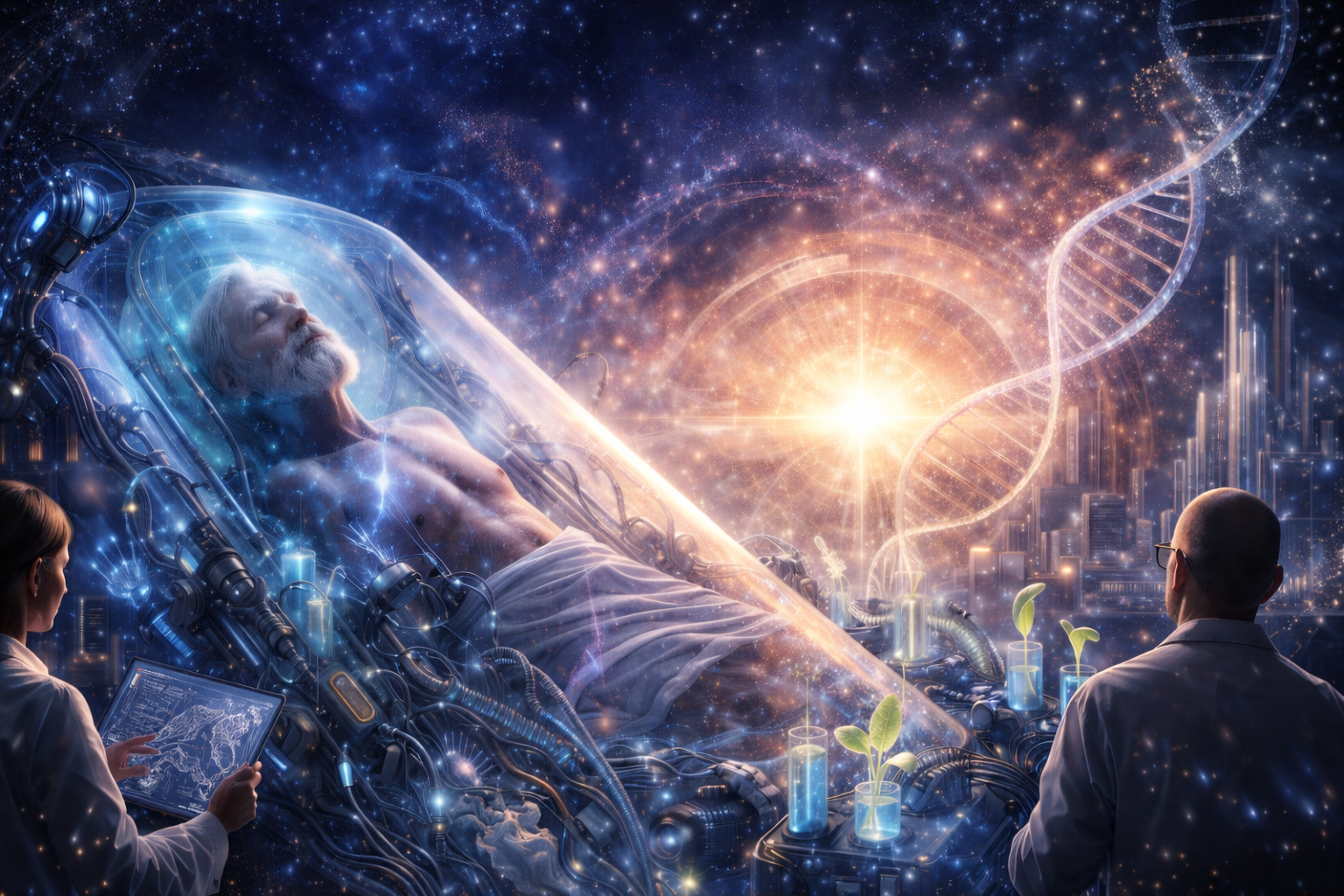
The Old Boundary
Every civilization has built its deepest stories in the shadow of mortality. Death has been the silent architect of urgency, inheritance, sacrifice, and faith. Religions promised meaning beyond it. Empires organized themselves against it. Families learned to love through it. Even our most intimate conceptions of time have been shaped by the assumption that life is brief, fragile, and irreversibly bounded.
Yet there are moments when a boundary long mistaken for permanence begins to look more like a technical condition. Aging, once regarded as an untouchable fact of existence, is increasingly being studied as a complex biological process rather than a metaphysical decree. Researchers supported by the National Institute on Aging’s Interventions Testing Program are explicitly evaluating interventions for their ability to decelerate aging and extend lifespan in animal models.
This shift in perspective is subtle but historic. The question is no longer only how to survive disease, but how to alter the underlying processes that make disease, frailty, and decline increasingly likely over time. The body is no longer viewed solely as an organism moving toward entropy; it is also becoming legible as a system whose rate of degradation may be measurable, modifiable, and perhaps eventually negotiable.
The Emergence of Longevity Science
Longevity science does not begin with fantasy. It begins with mechanisms. Scientists studying the biology of aging investigate cellular senescence, genomic instability, mitochondrial dysfunction, altered nutrient sensing, stem-cell exhaustion, and epigenetic change as possible contributors to age-related decline. At the same time, serious scholars have cautioned that some “hallmarks of aging” models can be overextended or treated too definitively, reminding us that the science remains powerful but incomplete.
That tension is important. Radical life extension is not an article of blind optimism; it is a disciplined wager that deeper understanding of aging biology can translate into longer healthspan, greater resilience, and eventually longer life itself. Organizations such as the Buck Institute for Research on Aging are building research infrastructure specifically focused on healthspan — the years of life spent in good health — reflecting a scientific consensus that extending vitality is at least as important as extending duration.
“The first victory over death may not be immortality, but the transformation of aging from fate into engineering.”
Healthspan Before Immortality
This distinction matters ethically. Popular imagination tends to leap immediately to visions of endless life, uploaded minds, or biologically indefinite existence. But responsible work in longevity research begins with a humbler and more urgent goal: reducing frailty, preserving function, and extending the years in which a human being remains capable, lucid, mobile, and meaningfully engaged with the world.
The World Health Organization’s work on ageing and health similarly frames the challenge around functional ability, care systems, and the social conditions that shape how people age. This is a crucial reminder that longer life, in the abstract, is not enough. A civilization worthy of radical life extension must ask not only whether people can live longer, but whether they can live more fully, more freely, and with greater dignity.
In that sense, the sacred project of radical life extension is not merely biomedical. It is civilizational. To extend human life without extending wisdom would produce a brittle future. To extend lifespan without justice could deepen inequality. To prolong existence without renewing purpose might leave humanity biologically preserved but spiritually diminished.
The Revaluation of Time
If human beings were granted decades more vitality than previous generations considered possible, our institutions would change with us. Education, marriage, vocation, parenthood, retirement, governance, and even concepts of maturity would require rethinking. A life of 120 vigorous years would not simply be a longer version of the present human schedule; it would demand a new architecture of meaning.
This is why radical life extension should be treated as more than a technical ambition. It is also a philosophical threshold. Mortality has always imposed scarcity on experience. It compressed the self into a narrow arc of becoming. If that compression loosens, then human beings may be called into deeper forms of deliberation, stewardship, and responsibility. Longer life could enlarge the horizon of conscience itself.
And yet prudence is required. Some scientific reviews continue to stress that the field still faces major uncertainties in how best to define and measure biological aging, and in how confidently results from model organisms map onto complex human systems. Radical life extension remains a frontier, not an accomplished fact. Its promise is real; its timetable is not guaranteed.
The Sacred Project
Why call this project sacred? Because it concerns one of the most ancient aspirations of conscious life: not merely to survive, but to preserve the conditions under which meaning, love, intelligence, and moral growth remain possible. To resist unnecessary decline is not to reject nature, but to continue humanity’s long struggle against suffering, limitation, and premature loss.
Properly understood, radical life extension is not a denial of spiritual seriousness. It is one expression of it. It asks whether compassion can be made technical, whether medicine can become civilizational foresight, and whether the future of the human organism can be guided rather than passively inherited.
The sacred project of radical life extension therefore stands before us as both invitation and test. It invites science to become wiser, ethics to become more future-facing, and human beings to imagine a civilization in which longer life serves deeper flourishing. If aging is even partially solvable, then the question is no longer whether humanity should think about it. The question is whether we are prepared to become equal to the responsibility of answering it.
Reflection — The possibility of extending human life forces us to reconsider one of civilization’s oldest assumptions: that mortality defines the horizon of meaning. If the boundaries of lifespan begin to expand, then the moral question is not simply how long we may live, but how wisely we choose to live. Longevity without purpose would be emptiness, but longer life guided by wisdom could deepen responsibility, compassion, and stewardship for the generations that follow.
Key Concepts
- Longevity Science — the study of biological mechanisms that influence aging, lifespan, and healthspan.
- Healthspan — the portion of life spent in good health, with preserved function and resilience.
- Biological Aging — the gradual molecular, cellular, and systemic changes associated with increased frailty and disease risk over time.
- Interventions Testing — experimental evaluation of compounds, diets, or therapies for their capacity to slow aging or extend lifespan.
- Radical Life Extension — the possibility that advances in biotechnology and aging research could significantly extend healthy human life beyond current norms.
Scientific Sources and Further Study
Readers who wish to explore the scientific frontier of aging biology, healthspan, and longevity research may begin with the following authoritative sources.